Kinematics is a branch of mechanics that deals with the study of motion without considering the forces that cause the motion.
Relative Motion:
When an object is in motion, its motion can be described relative to a reference point. Relative motion is the motion of an object with respect to another object or a reference point. It is important to choose an appropriate reference point to accurately describe the motion of an object.

Motion in the Same Direction:
When two objects move in the same direction, the relative velocity of one object with respect to the other object is the difference between their individual velocities. The relative speed of the objects is the absolute value of their relative velocity.
Motion in the Opposite Directions:
When two objects move in opposite directions, the relative velocity of one object with respect to the other object is the sum of their individual velocities. The relative speed of the objects is the absolute value of their relative velocity.
Rectilinear Motion under Constant Acceleration:
Rectilinear motion is motion along a straight line. When an object moves along a straight line with a constant acceleration, its velocity changes at a constant rate. The displacement of the object can be calculated using the equation s = ut + (1/2)at^2, where s is the displacement, u is the initial velocity, a is the acceleration, and t is the time taken.
Graphs of Motion:
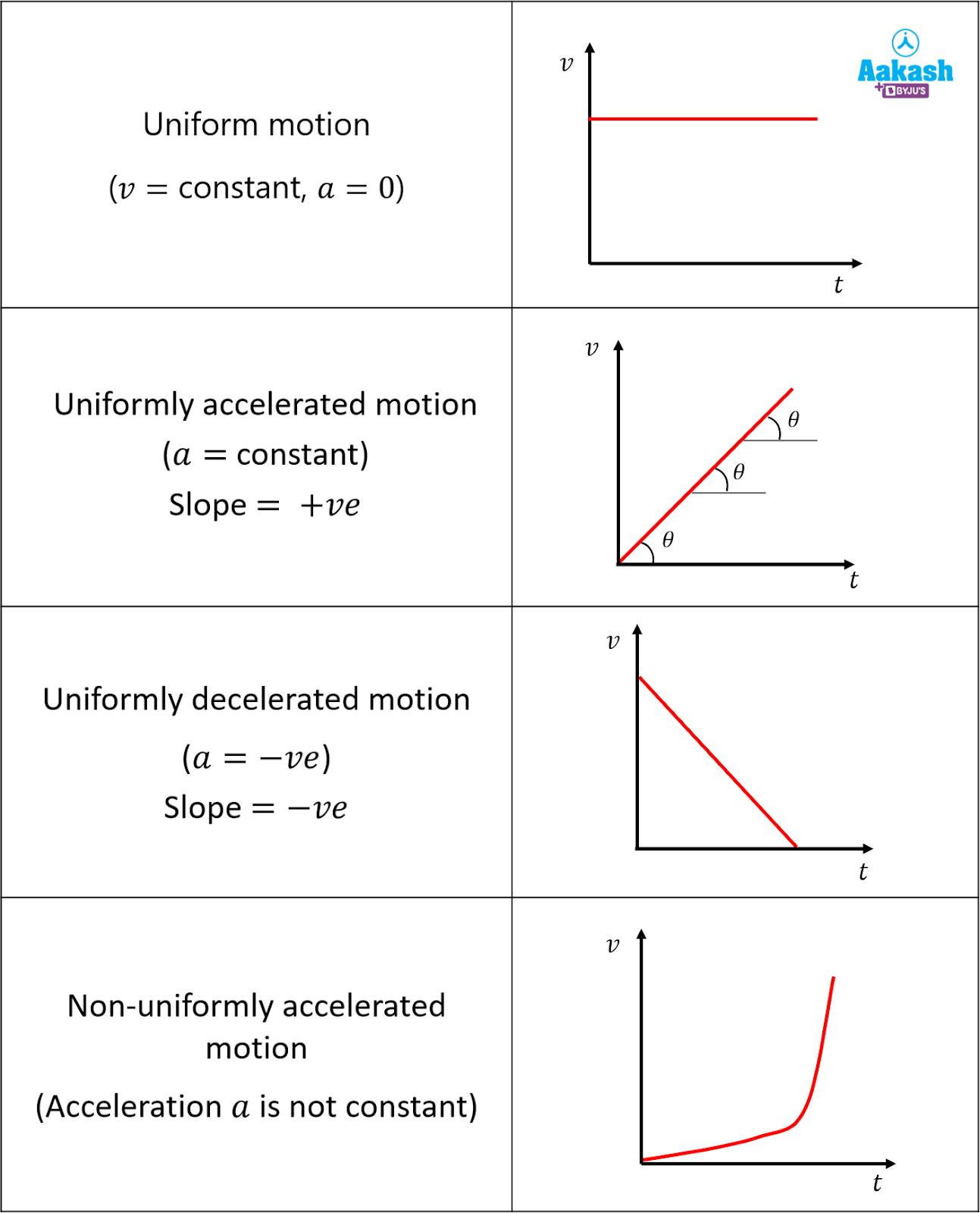
Motion can be graphically represented using position-time (s-t) graphs and velocity-time (v-t) graphs. These graphs provide a visual representation of the motion of an object.
s-t Graphs:
In an s-t graph, time is plotted on the x-axis, and position is plotted on the y-axis. The slope of the line on the s-t graph represents the velocity of the object.

v-t Graphs:
In a v-t graph, time is plotted on the x-axis, and velocity is plotted on the y-axis. The area under the curve on the v-t graph represents the displacement of the object.
Equations of Motion:
The equations of motion describe the motion of an object in a straight line. They can be used to calculate the displacement, velocity, acceleration, and time taken for an object to move a certain distance.
Motion in a Straight Line:
The equations of motion for an object moving in a straight line are:
s = ut + (1/2)at^2
v = u + at
s = (u + v)t/2
v^2 = u^2 + 2as
Projectile Motion under Gravity:

Projectile motion is the motion of an object that is launched into the air and moves along a curved path under the influence of gravity. The equations of motion for projectile motion are:
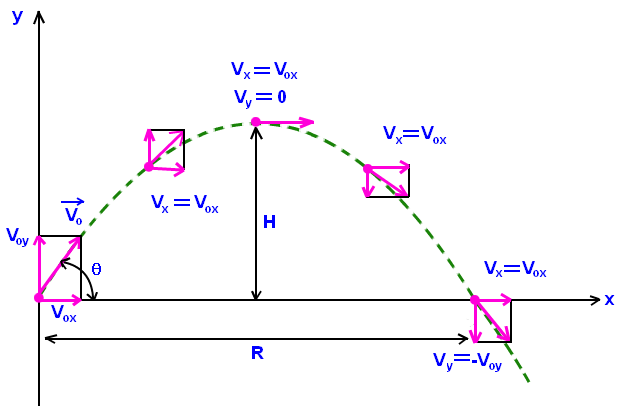
Range = (u^2 sin 2θ)/g
Maximum height = (u^2 sin^2θ)/2g
Time of flight = (2u sinθ)/g
where u is the initial velocity of the projectile, θ is the angle of projection, and g is the acceleration due to gravity.
Resultant of forces:
The resultant of forces is the single force that has the same effect as two or more forces acting on a body. It is a vector sum of all the forces acting on an object.
Resultant of two forces:
When two forces act on a body, the resultant force is the vector sum of the two forces. It can be found using the parallelogram law of vector addition or by resolving the forces into components.
Resultant of a system of coplanar forces:
A system of coplanar forces refers to a group of forces acting on the same plane. The resultant of a system of coplanar forces is found by adding the x-components and y-components of the forces separately.
Moment of a force:
The moment of a force is a measure of its turning effect on a body. It is equal to the product of the magnitude of the force and the perpendicular distance from the line of action of the force to the pivot point.
Moment of a force about a point:
The moment of a force about a point is the perpendicular distance between the line of action of the force and the point, multiplied by the magnitude of the force.
Moment of a couple (of forces):
A couple is a pair of equal and opposite forces that act on a body, but do not produce any net force on the body. The moment of a couple is equal to the product of one of the forces and the perpendicular distance between the two forces.
Resultant of parallel forces and the line of action (parallel forces in the same direction):
The resultant of parallel forces in the same direction is equal to the algebraic sum of the forces and acts along the line of action of the forces.
Centre of gravity of a body (using the resultant of parallel forces):
The centre of gravity of a body is the point where the weight of the body can be considered to act. It can be found using the principle of moments, which states that the sum of the moments of the weights of all the parts of the body about any point is zero.
Centre of gravity of regular shaped bodies:
For regular shaped bodies such as a cube, sphere or cylinder, the centre of gravity is at the geometric centre of the body.
Centre of gravity of regular shaped compound bodies:
For compound bodies made up of regular shapes, the centre of gravity can be found by considering the centre of gravity of each individual shape and using the principle of moments.
Centre of mass:
The centre of mass is the point at which the mass of an object is concentrated. It is the same as the centre of gravity if the gravitational field is uniform.
Determination of weight of a body using the law of parallelogram of forces:
The weight of a body can be determined by applying the law of parallelogram of forces. If the weight of a body is W, and the angles that the ropes make with the horizontal are θ1 and θ2, then the tension in the ropes is W/sin(θ1+θ2).
Force and motion:
Force is a physical quantity that is responsible for the motion of objects. It is defined as the push or pull on an object that causes it to change its state of motion. Motion is the change in position of an object with respect to time.
Mass:
Mass is a measure of the amount of matter in an object. It is a scalar quantity and is measured in kilograms (kg). Mass is an intrinsic property of an object, which means that it does not depend on the location of the object in space.
Inertial mass:
Inertial mass is the resistance of an object to a change in its state of motion. It is a measure of the object's tendency to maintain its current state of motion. The inertial mass of an object is equal to the ratio of the force applied to the object and the resulting acceleration.
Gravitational mass:
Gravitational mass is the property of an object that determines the strength of its gravitational attraction to other objects. The gravitational mass of an object is equal to the ratio of the force of gravity acting on the object and the resulting gravitational acceleration.
Inertial and non-inertial frames:
An inertial frame of reference is a reference frame that is not accelerating, or is moving with a constant velocity. In an inertial frame, the laws of physics are the same in all directions. A non-inertial frame of reference is a reference frame that is accelerating. In a non-inertial frame, the laws of physics are not the same in all directions.
Newton's first law of motion:
Newton's first law of motion states that an object at rest will remain at rest, and an object in motion will remain in motion with a constant velocity, unless acted upon by a net external force. This law is also known as the law of inertia. In other words, an object will not change its state of motion unless a force acts on it. This law applies to both inertial and non-inertial frames of reference.
Momentum:
Momentum is a physical quantity that describes the motion of an object. It is defined as the product of an object's mass and velocity. Momentum is a vector quantity, and its direction is the same as the direction of the object's velocity.
Newton's second law of motion:
Newton's second law of motion relates the net force applied to an object to its acceleration. It states that the net force acting on an object is equal to the product of its mass and acceleration. Mathematically, F = ma.
Obtaining F=ma:
To obtain the equation F = ma, we need to apply Newton's second law of motion. The net force applied to an object is equal to the rate of change of its momentum, which can be expressed as F = dp/dt, where p is the momentum of the object. Using the definition of momentum, we can rewrite this equation as F = d(mv)/dt = ma.
Defining the unit ‘newton’:
The newton is the SI unit of force. It is defined as the force required to give a mass of one kilogram an acceleration of one meter per second squared. Mathematically, 1 newton = 1 kg·m/s^2.
Impulse and impulsive forces:
Impulse is the change in momentum of an object caused by a force applied to it over a period of time. Impulse is equal to the product of the force and the time for which it is applied. Impulsive forces are those that act over a short period of time, causing a significant change in an object's momentum.
Principle of conservation of linear momentum:
The principle of conservation of linear momentum states that the total momentum of a system of objects remains constant if there are no external forces acting on the system. This principle is based on Newton's third law of motion.
Newton's third law of motion:
Newton's third law of motion states that for every action, there is an equal and opposite reaction. This means that when two objects interact, they exert equal and opposite forces on each other.
Applications of Newton's laws:
Newton's laws of motion have many applications in everyday life, such as the design of vehicles, the study of sports, and the analysis of accidents.
Self-adjusting forces:
Self-adjusting forces are those that adjust themselves in response to changes in the system. Examples of self-adjusting forces include tension in a rope and the compression or expansion of a spring.
Tension:
Tension is a force that is transmitted through a rope, cable, or similar object when it is pulled tight by forces acting on either end. Tension is always directed along the length of the rope.
Thrust/compression:
Thrust is a force that pushes an object away from a source. Compression is a force that squeezes an object towards a source. These forces are commonly seen in hydraulic and pneumatic systems.
Frictional forces:
Frictional forces are those that act between two surfaces in contact and oppose motion. There are three types of frictional forces: static friction, limiting friction, and dynamic friction.
Static friction:
Static friction is the force that opposes the initiation of motion between two surfaces in contact.
Limiting friction:
Limiting friction is the maximum value of static friction that can be overcome by an applied force without causing motion between two surfaces in contact.
Dynamic friction:
Dynamic friction is the force that opposes the motion of two surfaces in contact when they are already in motion relative to each other.
Free body force diagrams:
Free body force diagrams are diagrams that show all the forces acting on an object. They are used to analyze the motion of objects and to apply Newton's laws of motion.
Download our latest updated app "Advanced level physics" for physics lesson revisions
