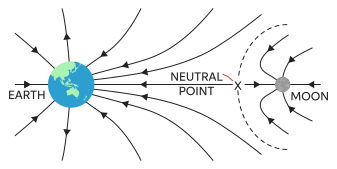
Gravitational Force Field
The gravitational force field is a fundamental concept in physics that describes the force of attraction between any two masses in the universe. This force is proportional to the product of the two masses and inversely proportional to the square of the distance between them. The constant of proportionality is known as the gravitational constant.
Gravitational Field
The gravitational field is the force per unit mass experienced by a small test mass placed at a point in space. It is a vector quantity, and its intensity is given by the gravitational force per unit mass. The gravitational field intensity is also a vector quantity and has the same direction as the gravitational field.
Gravitational Potential
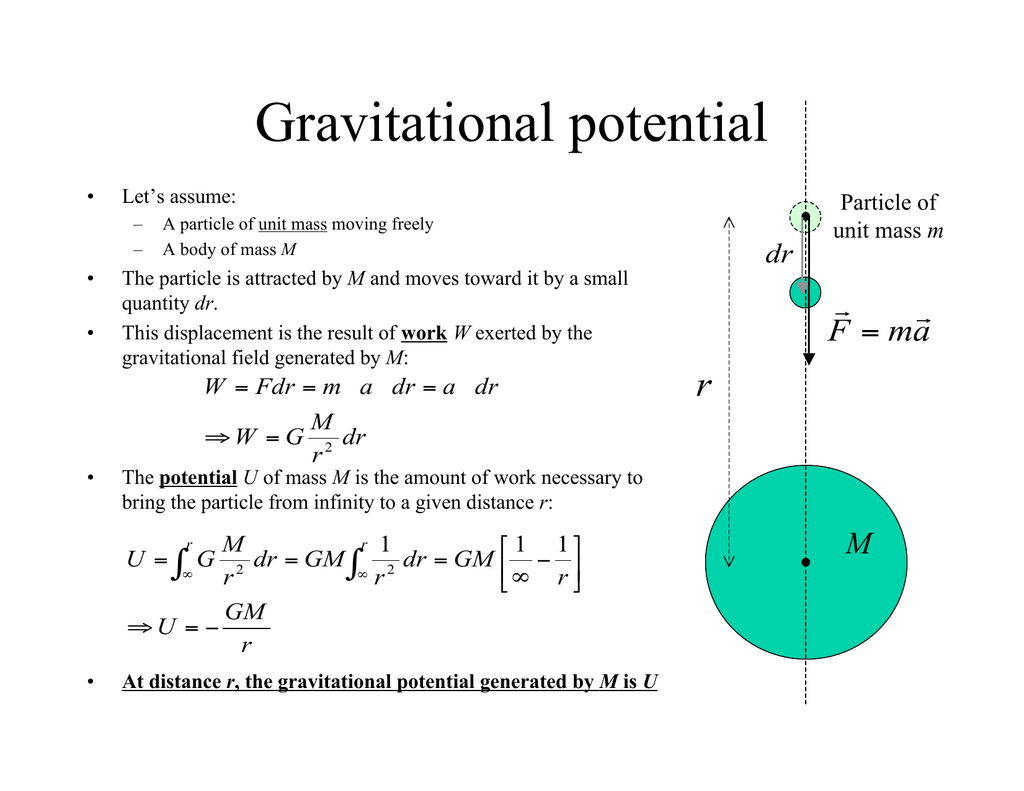
The gravitational potential is the work done per unit mass in bringing a small test mass from infinity to a point against the gravitational field. It is a scalar quantity and has units of J/kg. The potential decreases as the distance increases, and its graphical representation is a hyperbola.
Potential Energy
The potential energy of a mass in a gravitational field is given by the formula -G(mM)/r, where r is the distance between the two masses. The energy of a mass moving on a circular path of radius r around a spherical mass M is the sum of the kinetic and potential energies, given by the formula -G(mM)/2r.
Gravitational Force
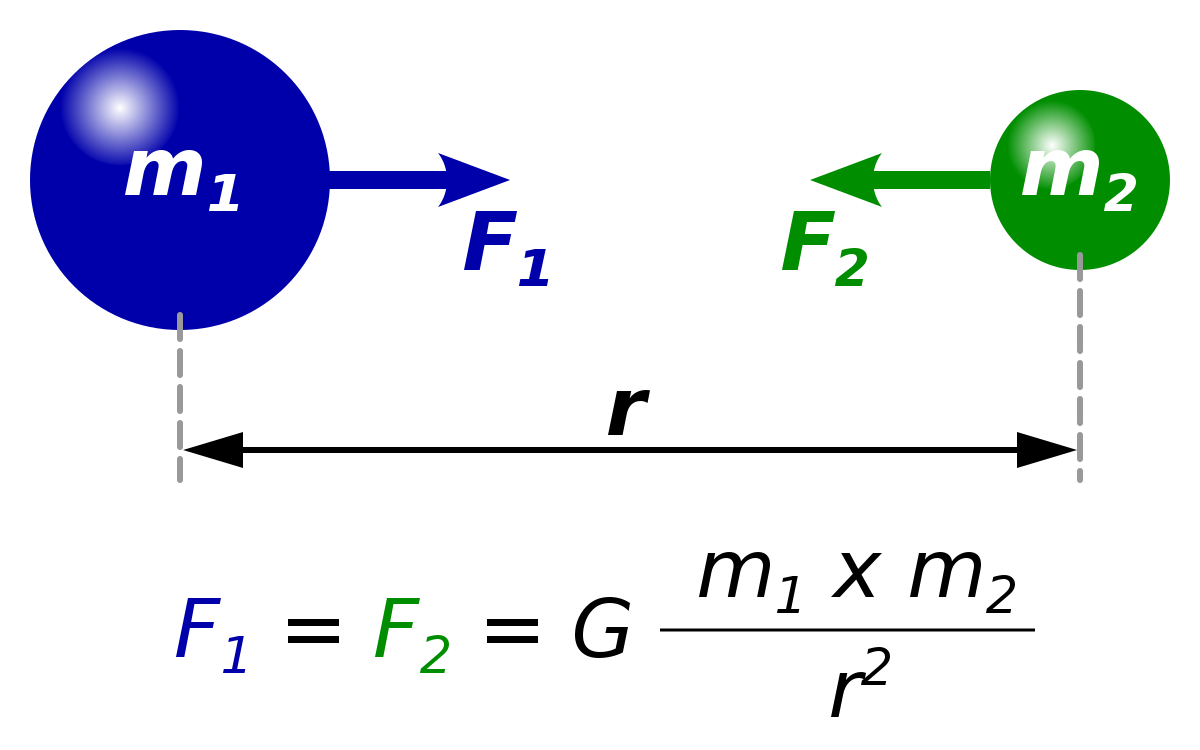
The gravitational force between two point masses m1 and m2 separated by a distance r is given by the formula F = G(m1m2)/r^2. Newton's law of universal gravitation states that every particle in the universe attracts every other particle with a force proportional to the product of their masses and inversely proportional to the square of the distance between them.
Newton's Law of Universal Gravitation
Newton's law of universal gravitation states that every particle in the universe attracts every other particle with a force proportional to the product of their masses and inversely proportional to the square of the distance between them.
Field Intensity
The gravitational field intensity at a point a distance r away from a point mass M is given by the formula g = GM/r^2. Similarly, the gravitational field intensity at a point outside a uniform spherical mass M is given by the formula g = GM/r^2, where r is the distance from the center of the sphere to the point. The graphical representation of the variation of field intensity with distance is a hyperbola.